
Early Life
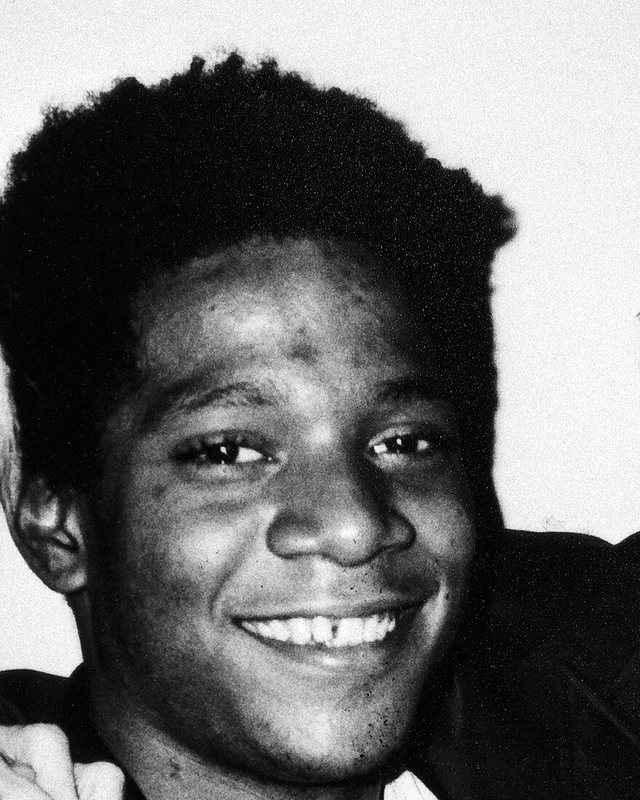
Jean-Michel Basquiat was born on 22 December 1960 in Brooklyn, New York, the second of four children of Matilde Basquiat, née Andrades, and Gérard Basquiat. His father was born in Port-au-Prince, Haiti, and his mother was born in Brooklyn to Puerto Rican parents. The household was multilingual, and by the age of eleven he was fluent in French, Spanish and English, and an avid reader in all three. His mother took him to museums and enrolled him as a junior member of the Brooklyn Museum, and she encouraged the drawing in which he showed an early gift.
In 1968, at the age of seven, he was struck by a car while playing in the street. He suffered a broken arm and internal injuries that required the removal of his spleen. During his recovery his mother gave him a copy of Gray's Anatomy, a book whose clinical diagrams of bones, organs and muscle he would return to throughout his career. That same year his parents separated, and he and his sisters were raised principally by their father. His mother, whose mental health had become fragile, was admitted to a psychiatric hospital and spent much of the rest of her life in and out of institutional care.
The family lived for a time in Puerto Rico, from 1974, and returned to Brooklyn in 1976. Basquiat was a restless teenager. He attended an alternative school in Manhattan, City-As-School, which accommodated students with artistic interests, but he left it in 1978, and at seventeen he was no longer living at his father's home. He supported himself with odd jobs and by selling hand-painted postcards and T-shirts, while the city around him, then in the grip of financial crisis, provided the raw material of his imagination.
SAMO and the Downtown Scene
In 1978 Basquiat and his schoolfriend Al Diaz began spray-painting cryptic, poetic slogans on walls in Lower Manhattan under the shared pseudonym SAMO. The phrases parodied the language of advertising, religion and politics, and they were signed with a small copyright symbol. A feature in The Village Voice in December 1978 brought the anonymous writers some notoriety. When the collaboration ended in 1980, Basquiat marked the walls of SoHo with the announcement that SAMO was dead.
In these years he was immersed in the downtown music and club scene. In 1979 he co-founded the noise band Gray, which performed at venues including Max's Kansas City, CBGB and the Mudd Club, and he appeared on Glenn O'Brien's public-access programme TV Party. He befriended other young artists, among them Keith Haring and Kenny Scharf, and he filmed the independent feature that was later released as Downtown 81, in which he appears as himself.
His first public exhibitions followed quickly. In June 1980 he was included in The Times Square Show, a large group exhibition organised by the artists' collective Colab, and in February 1981 he took part in New York/New Wave at P.S.1, curated by Diego Cortez. In May of that year the Italian dealer Emilio Mazzoli gave him his first solo exhibition in Modena. The critic René Ricard published a long article in Artforum in December 1981 under the title The Radiant Child, which introduced Basquiat to the wider art world.
Breakthrough, 1981 to 1983
In the autumn of 1981 the dealer Annina Nosei invited Basquiat to join her SoHo gallery, where she provided materials and a space in which to work, and where his first American solo exhibition took place in March 1982. The paintings of this period are made with oil stick, acrylic and spray paint, often on canvases stretched on exposed wooden supports, and they have an urgent, improvised look. Figures resemble masks or skulls, crowns hover above heads, and words and numbers are written, struck out and written again. The deletions are often read as a way of drawing attention to the words they strike through.
By the summer of 1982 Bruno Bischofberger had become his principal international dealer. In June 1982, at twenty-one, Basquiat became the youngest artist ever to take part in documenta in Kassel, where he was exhibited alongside established figures such as Joseph Beuys and Cy Twombly. His first exhibition at the Fun Gallery in the East Village followed in November, and he spent time working in a studio provided by the dealer Larry Gagosian in Venice, California. In March 1983 he was among the youngest artists to appear in the Whitney Biennial. While in Los Angeles, he painted Hollywood Africans, a portrait of himself with the graffiti artists Toxic and Rammellzee.
The subjects of these years reflect a very wide range of reference. Basquiat drew on Gray's Anatomy, on books about African art and the African diaspora, on Leonardo da Vinci, on the Symbol Sourcebook, and on cartoons, street signs and the labels of everyday products. He admired Abstract Expressionists, Jean Dubuffet, Cy Twombly and Robert Rauschenberg, and he took inspiration from jazz and from early hip hop. In 1983 he produced the record Beat Bop, with the artist Rammellzee and the rapper K-Rob, and designed its cover.
The Language of the Work
Basquiat's surfaces are typically covered in codes of every kind: words, letters, numerals, pictograms, logos, map symbols and diagrams. The paintings of what is often called his middle period, from late 1982 to 1985, include multi-panel works and canvases with exposed stretcher bars, dense with writing, collage and imagery. Between 1983 and 1985 he also made several works in collaboration with Andy Warhol and with the Italian artist Francesco Clemente. The drawings, painted objects and found surfaces that he made show that the conjunction of different media was integral to his art, from the postcards and clothing of his earliest years to his largest canvases.
The recurring themes of the paintings are race, class and power, and the experience of being a young black artist in an art world that was overwhelmingly white. Basquiat paid homage to musicians such as Charlie Parker and to athletes and other black heroes, and he treated slavery, colonialism and the history of the African diaspora with directness. Irony of a Negro Policeman, from 1981, addresses the position of black Americans within institutions of authority.
In September 1983 Michael Stewart, a young black artist, died after being detained by New York City transit police. Basquiat, who was deeply affected, painted Defacement (The Death of Michael Stewart) the same year, and he took part in a benefit for Stewart's family. The picture, which was the subject of a study at the Guggenheim Museum in 2019, shows the extent to which his work could respond directly to events in the city.
Basquiat's drawing, too, deserves attention. He filled notebooks with writing, lists and diagrams, and he made works on paper throughout his career. A major exhibition of the notebooks at the Brooklyn Museum in 2015 gave the public its first extensive view of them, revealing a poet's attention to the sound and appearance of words as much as a painter's.
Fame and the Warhol Collaboration
In August 1983 Basquiat moved into a loft at 57 Great Jones Street in NoHo, a building owned by Andy Warhol, which served as both home and studio. He had first met Warhol in 1979, when he sold him a postcard at a SoHo restaurant, and the two grew close in the mid-1980s. Between 1984 and 1985 they collaborated on a series of paintings, among them Olympics and Taxi, 45th/Broadway. Their joint exhibition at the Tony Shafrazi Gallery in 1985 was poorly received by some critics, and the reception caused tension in the friendship.
By then Basquiat was a celebrity. Having joined the gallery of Mary Boone in SoHo in 1983, he held his first exhibition there in May 1984. He appeared on the cover of The New York Times Magazine on 10 February 1985 in a story about the marketing of a young American artist. He was interviewed on television, worked as a DJ for fun at the Area nightclub, painted murals for the Palladium, and appeared in fashion shows for the designer Rei Kawakubo of Comme des Garçons. He was known for painting in expensive suits, and was often photographed with paint across them.
He exhibited widely in these years. In 1986 he showed in Los Angeles, Atlanta and Salzburg, and in October of that year he travelled to Abidjan, in Ivory Coast, for an exhibition organised by his dealer at the French Cultural Institute, his first journey to Africa. In 1987 he showed in Paris, Tokyo and New York.
The Final Years
The pressures of fame, of an art market that he sometimes found exploitative, and of his own history weighed on him. He struggled with drug use, and in the last eighteen months of his life he became increasingly withdrawn. The death of Warhol in February 1987, after a routine surgical procedure, was a heavy blow, and friends have described him as increasingly isolated afterwards. He nevertheless continued to work, travelling to Paris and Düsseldorf in early 1988 for exhibitions, and meeting the Ivorian artist Ouattara Watts, with whom he planned a journey to West Africa. In April 1988 his work was shown at the Vrej Baghoomian Gallery in New York.
Jean-Michel Basquiat died at his home on Great Jones Street on 12 August 1988, at the age of twenty-seven, of a heroin overdose. He is buried at Green-Wood Cemetery in Brooklyn. In an obituary tribute, Keith Haring wrote that Basquiat had created a lifetime of work in ten years. The remark has proved apt. Although his career lasted barely a decade, it produced a large body of paintings, drawings and notebooks, and the work has continued to grow in reputation.
Legacy and Market Context
The first museum retrospective of Basquiat's work opened at the Whitney Museum of American Art in 1992, and it travelled to several American museums. A major retrospective at the Brooklyn Museum followed in 2005. Subsequent exhibitions have included Boom for Real at the Barbican Centre in London in 2017, the Guggenheim's study of Defacement in 2019, and King Pleasure, an exhibition curated by his family in New York in 2022. His life has been the subject of documentary and feature films, and his imagery has entered popular culture around the world.
Critics now place Basquiat among the central artists of his generation. The critic Franklin Sirmans has described how he combined poetry, drawing and painting, and married text and image, abstraction and figuration, history and contemporary critique. He joined the immediacy of street writing to the history of painting, and his preoccupations with identity, inequality and language remain current. His influence on later painters, musicians and designers is acknowledged widely.
For collectors, the market for Basquiat is a demanding one. His estate was administered through the Robert Miller Gallery after his death, which established an authentication committee in the 1990s to address the problem of forgeries; the committee announced in 2012 that it would stop considering applications. Authentication therefore rests today on scholarship, on documented provenance and exhibition history, and on informed independent opinion, and the estate, managed by his family, remains an important voice in the care of his legacy. Any discussion of a specific work should begin with its documented history, with careful condition and attribution review, and with independent verification.