
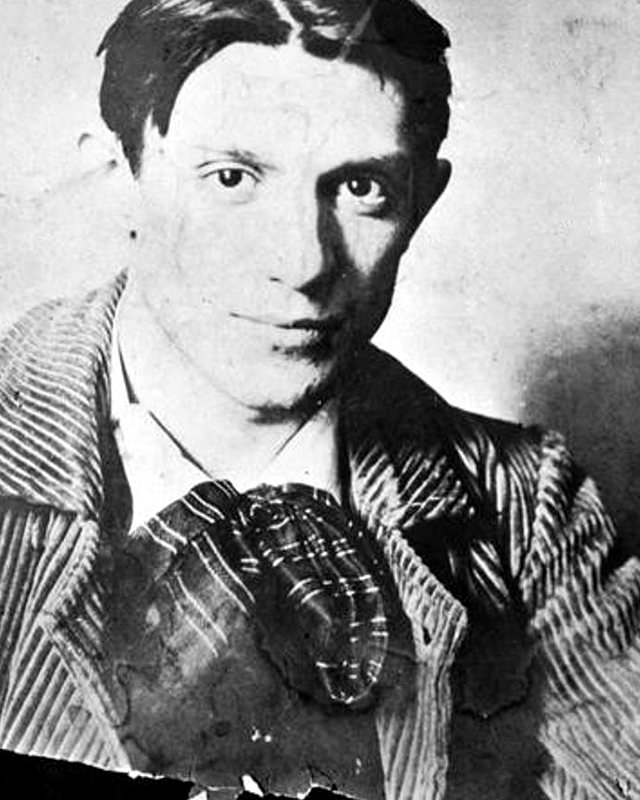
Early Life and Training
Pablo Ruiz Picasso was born on 25 October 1881 in Málaga, on the southern coast of Spain. His father, José Ruiz y Blasco, was a painter and art teacher who specialised in naturalistic subjects, and his mother was María Picasso y López. The boy would later sign his work with his mother's surname, the less common of the two, and it is by that name that he became known throughout the world. Those who knew the family recalled that he drew with remarkable fluency from earliest childhood, and that his father, recognising the gift, gave him a rigorous academic grounding while he was still a boy.
In 1891 the family moved to A Coruña, in Galicia, where José Ruiz took a post teaching at a secondary school, and in 1895 they settled in Barcelona. There the thirteen-year-old Picasso was admitted to the School of Fine Arts, known as La Llotja, where his father also taught. The entrance work that was normally expected to take a month is said to have been completed by the young artist in a matter of days. Barcelona, a cosmopolitan Catalan port city with a lively modernist culture, would remain central to his imagination for the rest of his life.
His early canvases, among them the large academic composition Science and Charity of 1897, show a young painter fully capable of the finished, narrative realism that the Spanish academies prized. In 1897 he travelled to Madrid to study at the Royal Academy of San Fernando, but he found the instruction tedious and was soon spending his time in the Prado, studying Velázquez, El Greco and Goya. A period of convalescence in the Catalan village of Horta de Ebro in 1898 gave him a lasting taste for the landscape of the countryside, and on his return to Barcelona he joined the circle of artists and writers who gathered at the café Els Quatre Gats, where he held his first solo exhibition in 1900.
Paris and the Blue Period
Picasso made his first visit to Paris in the autumn of 1900, travelling with his friend the painter Carlos Casagemas, and one of his canvases was shown in the Spanish section of the Exposition Universelle. He returned several times over the following years, dividing his time between Barcelona, Madrid and the French capital. In February 1901 Casagemas took his own life in Paris, and the loss marked Picasso profoundly. Within months his palette had shifted to cold blues and blue-greens, and his subjects to the poor, the blind, the hungry and the isolated.
The years from about 1901 to 1904 are known as the Blue Period. The paintings of these years are marked by elongated, mournful figures, a restrained and almost monochrome colour scheme, and a gravity that distinguishes them from the work of his Parisian contemporaries. The Old Guitarist, painted in Barcelona in 1903 and 1904, is one of the best-known works of the phase, and it reflects the influence of El Greco in its attenuated forms. Although the paintings were not at first widely collected, the Blue Period established the emotional register and the confidence of line on which his later experiments depended.
In the spring of 1904 Picasso moved permanently to Paris, taking a studio in a ramshackle building on the slope of Montmartre that his friend the poet Max Jacob nicknamed the Bateau-Lavoir. It was a community of painters, poets and dealers, and he found there an atmosphere of poverty, camaraderie and intense conversation. Among those he met were the poet Guillaume Apollinaire and, soon afterwards, Fernande Olivier, who became his companion for several years.
The Rose Period and the Road to Cubism
Around 1904 and 1905 his work grew warmer, with pinks, ochres and soft reds replacing the blues. The Rose Period, as it is called, draws its subjects largely from the world of the circus and the travelling players, the acrobats, harlequins and saltimbanques that Picasso watched at the Cirque Medrano near Montmartre. The pictures are tender, but they are also austere, with figures set in open, empty landscapes and a feeling of suspended time. Family of Saltimbanques, completed in 1905 and now in the National Gallery of Art in Washington, is the summit of the period.
During these years Picasso began to attract serious collectors. Leo and Gertrude Stein, American siblings living in Paris, bought his work and introduced him to their circle, and the dealer Ambroise Vollard also took an interest. In 1905 and 1906 he painted Gertrude Stein's portrait, a picture now at the Metropolitan Museum of Art in New York, which is notable for the mask-like treatment of the face. The influence of ancient Iberian sculpture, which he had seen in the Louvre, and of the work of Paul Cézanne, whose memorial exhibition took place in Paris in 1907, was beginning to alter his thinking about form.
The result was Les Demoiselles d'Avignon, begun in the winter of 1906 and 1907 and now in the Museum of Modern Art in New York. Its five nude figures, their bodies fractured into angular planes and two of their faces recalling African masks, deliberately abandoned the conventions of perspective and idealised beauty that had governed European painting since the Renaissance. The picture was not exhibited publicly for many years, but those who saw it in the studio, including Braque, understood that something decisive had happened.
Cubism
Georges Braque, who had been struck by the Demoiselles, became Picasso's closest collaborator from about 1908. Working in near-daily dialogue, the two painters developed Cubism, a style that dismantled the single, fixed viewpoint of traditional perspective and presented objects from several angles simultaneously. In the phase now called Analytic Cubism, which lasted until about 1912, their canvases were built from small, faceted planes in restrained browns, greys and ochres, so that subject and surrounding space seem to dissolve into one another. Portraits of the dealers Ambroise Vollard and Daniel-Henry Kahnweiler, and still lifes of guitars, bottles and glasses, are among the principal subjects.
From about 1912 the two artists moved towards Synthetic Cubism, in which flat, brighter shapes were assembled rather than analysed. Picasso's Still Life with Chair Caning of 1912, which incorporated a piece of oilcloth printed with a chair-caning pattern, is generally regarded as the first collage in the history of modern art, and the papiers collés of this period introduced newsprint, wallpaper and sheet music into fine art. He also made constructed sculptures from sheet metal and wire, which opened up possibilities that sculptors would explore for decades.
The partnership ended with the outbreak of the First World War in 1914, when Braque was called up for military service. Kahnweiler, who had been the principal dealer of both artists, was a German national and his gallery stock in France was confiscated during the war. Cubism, however, had by then spread across Europe and beyond, and its influence on Futurism, Constructivism, De Stijl and later abstraction was profound.
Theatre, Classicism and Surrealism
In 1917 Picasso travelled to Rome with the writer Jean Cocteau to work on Parade, a ballet for Serge Diaghilev's Ballets Russes, with music by Erik Satie and choreography by Léonide Massine. Picasso designed the sets and costumes, including an enormous front curtain, and the production, first given in Paris in May 1917, caused a minor scandal. In Italy he also saw the monuments of Rome, Naples and Pompeii, and he married the Russian dancer Olga Khokhlova in 1918. Their son Paulo was born in 1921.
In the years following the war Picasso's work took on a new monumentality, drawing on classical sculpture and on Ingres. Large, calm figures of women and children appear in paintings and drawings of the early 1920s, and he moved with ease between this classicising manner and a late, highly colourful form of Cubism, as in the two versions of Three Musicians of 1921. Critics at the time were sometimes puzzled that the creator of Cubism should return to naturalistic drawing, but for Picasso style was never a doctrine; it was a language to be used as the subject demanded.
By the mid-1920s he had come into contact with the Surrealists, whose poets, notably André Breton, admired his work, though he never formally joined the movement. The Three Dancers of 1925 introduced a violent, emotionally charged distortion that would define his work for many years. In the following decade, he made sculptures at his country house at Boisgeloup in Normandy, produced the celebrated series of etchings known as the Vollard Suite between 1930 and 1937, and explored the figure of the Minotaur, which became a recurring symbol. His relationships with Marie-Thérèse Walter, and later with the photographer and painter Dora Maar, inspired some of his most sensuous and most anguished portraits.
War, Guernica and the Occupation
In January 1937 the Spanish Republican government, then fighting the Civil War, commissioned Picasso to produce a large mural for its pavilion at the International Exposition in Paris. On 26 April 1937 the Basque town of Guernica was bombed by German and Italian aircraft supporting the Nationalist forces, and the news reached Paris within days. Picasso responded with Guernica, a monumental painting in black, white and grey, which he completed in a matter of weeks in his studio on the rue des Grands-Augustins. The picture contains no explicit depiction of aircraft or bombs. Instead, a bull, a horse, a grieving mother and fallen figures are compressed into a single, tightly organised, shattered space.
After the Exposition, Guernica toured Europe and the United States to raise funds for Spanish refugees and was entrusted to the Museum of Modern Art in New York, where it remained for decades. Picasso had stipulated that it should not go to Spain until liberty and democratic institutions were restored. Following the death of Franco in 1975 and the return of democracy, it was transferred to Madrid in 1981, and it is now in the Museo Nacional Centro de Arte Reina Sofía.
Picasso spent the Second World War in occupied Paris. He was not permitted to exhibit, and he continued to work in his studio, producing still lifes, portraits and sculptures, among them the bronze Man with a Sheep. In October 1944, after the liberation of Paris, he joined the French Communist Party, an act that attracted considerable attention and which he maintained for the rest of his life.
The Later Decades
After the war Picasso moved increasingly to the south of France. At Vallauris, near Antibes, he worked at the Madoura pottery from 1947, creating thousands of ceramic pieces that brought a new playfulness to the medium. His lithograph of a dove was chosen as the emblem for the World Peace Congress held in Paris in 1949. With the painter Françoise Gilot he had two children, Claude and Paloma. In the 1950s he engaged with the old masters directly, painting a series of variations on Velázquez's Las Meninas in 1957, as well as versions of works by Delacroix and Manet.
In 1961 he married Jacqueline Roque, and the couple settled at Notre-Dame-de-Vie in Mougins, where he worked with undiminished intensity into his tenth decade. His last paintings and prints, executed with rapid, expressive brushwork and frank, often erotic subjects, were once dismissed as the products of old age but have been re-evaluated by later scholars as an important late style. Large public commissions also continued, among them the monumental untitled sculpture installed in Chicago in 1967. Pablo Picasso died at Mougins on 8 April 1973, at the age of ninety-one, and was buried in the grounds of the Château de Vauvenargues, near Aix-en-Provence, which he had acquired in 1958.
Legacy and Market Context
Few artists have shaped the twentieth century as thoroughly as Picasso. With Braque he transformed the grammar of painting; his collages and constructions altered the idea of what a work of art could be made from; and his example freed generations of artists to change style, medium and subject without apology. He was extraordinarily prolific, working in painting, drawing, printmaking, sculpture, ceramics and stage design, and his output runs to tens of thousands of works.
Institutions devoted to his work include the Museu Picasso in Barcelona, which opened in 1963 in the artist's lifetime, and the Musée National Picasso-Paris, established after his death with works that his heirs transferred to the French state in lieu of estate duties, and opened to the public in 1985. Major holdings of his work are also found at the Museum of Modern Art in New York, the Musée de l'Orangerie and the Museo Reina Sofía, among many other museums.
For the collector, the breadth of Picasso's career means that period, medium, subject and, above all, provenance carry great weight. The principal reference for his paintings and drawings is the catalogue compiled by Christian Zervos, published in thirty-three volumes between 1932 and 1978, supplemented by later scholarship, and the rights in his work are administered by his heirs. Works appear in the private and public markets across every medium he used, from major canvases to prints and ceramic editions. Any discussion of a specific work properly begins with its documented history, its exhibition and publication record, and independent verification of its authenticity.