
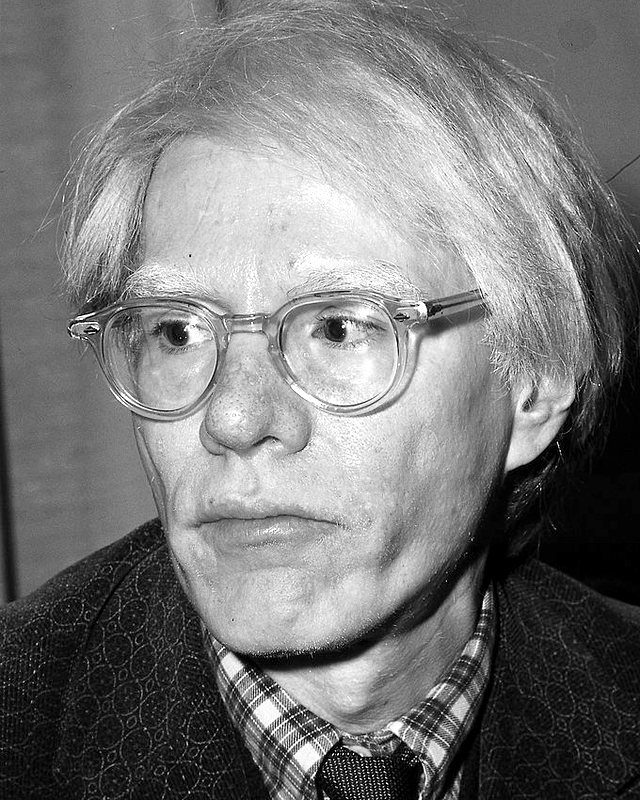
Early Life
Andy Warhol was born Andrew Warhola Jr. on 6 August 1928 in Pittsburgh, Pennsylvania, the fourth child of Andrej and Julia Warhola, working-class Rusyn emigrants from the village of Miková, in what is now northeastern Slovakia. His father had emigrated to the United States in 1912 and worked in a coal mine; his mother joined him in 1921. The family belonged to the Ruthenian Catholic church and lived in the Oakland district of Pittsburgh, where religious imagery and the rituals of the Byzantine Catholic liturgy formed part of the world in which he grew up.
At the age of eight Warhol contracted scarlet fever, which developed into the neurological disorder Sydenham's chorea. For long periods he was confined to bed and kept away from school, passing the time in drawing, assembling scrapbooks from Hollywood magazines and cutting out images from the comic books his mother bought him. He was also given a small box camera, and his father and brothers later built a darkroom for him in the family's basement. Several biographers have seen in these months of seclusion the origins of his lifelong fascination with film stars, popular imagery and mechanical reproduction.
In 1937 he began art classes at the Holmes School, where a teacher recognised his talent and arranged for him to attend Saturday drawing classes at the Carnegie Institute. His father died in 1942, when Warhol was thirteen. He went on to Schenley High School and then, with a scholarship, to the Carnegie Institute of Technology in Pittsburgh, where he studied pictorial design and earned a Bachelor of Fine Arts in 1949. While a student he worked part-time as a window dresser at a department store and served as art director of the student art magazine.
Commercial Artist in New York
After graduating in June 1949, Warhol moved to New York with his classmate Philip Pearlstein. Within days he had called on the art director of Glamour magazine, who commissioned shoe illustrations for the September 1949 issue, and so began a career as a commercial artist that would be remarkably successful. His distinctive technique in these years, the blotted line, combined elements of drawing and printmaking, and gave his illustrations a hand-made and slightly fragile quality that clients found appealing.
His commercial work embraced magazines, advertisements, television title cards and record sleeves. In 1952 he won an Art Directors Club Medal for an illustration promoting a CBS Radio programme, and the same year his first solo exhibition, Fifteen Drawings Based on the Writings of Truman Capote, was held at the Hugo Gallery in New York. In the later 1950s he distributed self-published books of his illustrations to potential clients, often including calligraphy by his mother, and designed album covers for RCA Records. In 1960 he bought a townhouse on Lexington Avenue in Manhattan, where he lived and worked, and where his mother lived in the basement.
Throughout the period, Warhol was also a serious collector of the work of other artists. He was aware that the New York art world of the late 1950s, dominated by Abstract Expressionism and its heirs, looked down on commercial artists, and that his reputation in advertising caused some tension with the galleries. He was determined, nonetheless, to become an artist in his own right.
The Turn to Pop
In 1961 Warhol began to paint subjects drawn from comic strips and newspaper advertisements, and in April of that year five of these works were shown in the window of the Bonwit Teller department store on Fifth Avenue. The painter Roy Lichtenstein was working along similar lines, and Warhol's dealers and friends advised him to look for a subject of his own. He turned to everyday consumer goods, to dollar bills and soon to the Campbell's Soup Cans, which he painted in 1961 and 1962 as a series of thirty-two canvases, each depicting a different variety of soup.
The series was exhibited at the Ferus Gallery in Los Angeles, which opened on 9 July 1962, and it marked his debut on the West Coast. In the same period he took up the silkscreen technique, which allowed an image to be transferred photographically to canvas and repeated. His first solo Pop exhibition in New York opened at the Stable Gallery on 6 November 1962 and was favourably reviewed.
After the death of Marilyn Monroe in August 1962 he began his celebrated series of silkscreen portraits of the actress, including the Marilyn Diptych of that year, in which a single publicity photograph is repeated fifty times, half of it in colour and half in black and white, so that the image seems to fade as it multiplies. The Coca-Cola bottles of 1962 belong to the same moment. The fascination with mass-produced goods and celebrity that governed these works has since become synonymous with Pop art.
The Factory Years
In January 1963 Warhol rented an old firehouse on East 87th Street, where he produced the Elvis series, among them Eight Elvises and Triple Elvis, and portraits of Elizabeth Taylor. In the same period he began his Death and Disaster paintings, based on newspaper photographs of car crashes, electric chairs and suicides, in which repetition and mechanical printing give subjects of tragedy a chilling, anonymous quality. By 1964 he had moved to a studio at 231 East 47th Street, which became known as the Factory. Its walls were covered in aluminium foil and silver paint, and it became a gathering place for artists, poets, musicians, socialites and a shifting cast of personalities known as the Warhol superstars.
Working with assistants, among them the poet Gerard Malanga, Warhol produced silkscreen paintings in quantity and deliberately blurred the distinction between the individual artist and the studio enterprise. In 1964 he exhibited sculptures of commercial cartons, such as Brillo Soap Pads and Heinz Tomato Ketchup, at the Stable Gallery, and in November the first of his Flowers series was shown at the Leo Castelli Gallery. When a second Flowers series was exhibited in Paris in 1965, he announced that he intended to give up painting and concentrate on film.
His films of the 1960s include Sleep, Empire, Blow Job and the two-screen Chelsea Girls of 1966. He also managed the rock band the Velvet Underground, and presented them with the singer Nico at the multimedia events known as the Exploding Plastic Inevitable in 1966 and 1967. In 1965 the Institute of Contemporary Art in Philadelphia gave him his first museum exhibition.
Shooting and Recovery
On 3 June 1968 Valerie Solanas, a writer who had appeared in one of his films, shot Warhol and the art critic Mario Amaya at the Factory. Amaya was lightly wounded, but Warhol was gravely injured and spent nearly two months in hospital. The attack changed him profoundly, according to those who knew him, and he suffered lasting physical consequences. When he returned to work, he reorganised the Factory as a more orderly business, and the film direction was taken over to a significant degree by Paul Morrissey.
The Business of Art
In the 1970s Warhol turned increasingly to portraiture, accepting commissions from wealthy collectors, socialites and public figures, and rendering their faces in silkscreen and acrylic. In 1969 he had founded Interview magazine, which became a showcase for celebrity culture. He also published The Philosophy of Andy Warhol in 1975, and in 1980 the memoir Popism: The Warhol Sixties. For his portrait commissions he often worked from photographs that he took himself with a Polaroid camera. He would typically take many pictures of a sitter and then select a single image, which was transferred to a silkscreen and overlaid with areas of flat, brilliant colour, so that a likeness became something close to a graphic emblem. He painted the Mao series of 1972 and 1973, the Athletes of 1977 and the Torsos and Sex Parts series, and he was a regular fixture of the New York nightlife of the period, including Studio 54.
He famously treated business as a form of art, a position that perplexed many critics but which he made explicit in his writing. The Warhol enterprise took in painting, film, publishing, television and fashion, and in the early 1980s he produced television programmes for cable. Throughout, he documented his own life, taking thousands of photographs and recording telephone conversations, and keeping a daily diary, later edited and published after his death as The Andy Warhol Diaries. He also saved the ephemera of his everyday life in cardboard boxes, which are now known as the Time Capsules.
Late Work and Death
In the 1980s Warhol made new series including the Myths of 1981, which transformed figures such as Mickey Mouse, Superman and Uncle Sam into icons, and the Reigning Queens and Statues of Liberty. He formed friendships with a younger generation of painters, among them Jean-Michel Basquiat, Keith Haring, Julian Schnabel and Francesco Clemente, and he collaborated with Basquiat on a series of paintings that were exhibited at the Tony Shafrazi Gallery in September 1985. In his last years he returned to religious themes in his Last Supper paintings of 1986, which were shown in Milan in January 1987, and he produced a late series of self-portraits.
Warhol had long avoided medical treatment because of his fear of hospitals, and he postponed surgery for a gallbladder condition for years. He was admitted to New York Hospital on 20 February 1987, and underwent an operation the following day. Early on 22 February he died, at the age of fifty-eight, of a sudden cardiac arrhythmia. He was buried near his parents in Pittsburgh. His will established the Andy Warhol Foundation for the Visual Arts, which was set up in 1987 to administer his estate and to support contemporary visual art, and which has become one of the largest grant-making organisations for the visual arts in the United States.
Legacy and Market Context
Warhol is widely regarded as one of the most influential artists of the second half of the twentieth century. By taking his subjects from advertising, supermarkets and the mass media, and by adopting the methods of commercial production, he redefined the relationship between high art and popular culture, and anticipated the preoccupation of later artists with fame, branding and reproduction. The phrase fifteen minutes of fame is associated with him, although its precise origin is debated.
The Andy Warhol Museum in Pittsburgh, which opened in 1994, is the largest museum in the United States dedicated to a single artist, and holds the principal collection of his work and archives. His work is also held by the leading modern museums throughout the world, including the Museum of Modern Art in New York and Tate in London, and he has been the subject of many major retrospectives.
For the collector, Warhol's output presents particular questions. Many of the works exist as editions, as series or in multiple versions, and the studio's method of production makes attention to documentation essential. The Andy Warhol Foundation established an authentication board in 1995, which was dissolved in 2012 following costly legal disputes, and it continues to oversee publication of the Andy Warhol Catalogue Raisonné, a multi-volume scholarly catalogue of the paintings and sculptures. Provenance, exhibition history, the catalogue raisonné and independent expert opinion are therefore the essential starting points for any consideration of a specific work.