
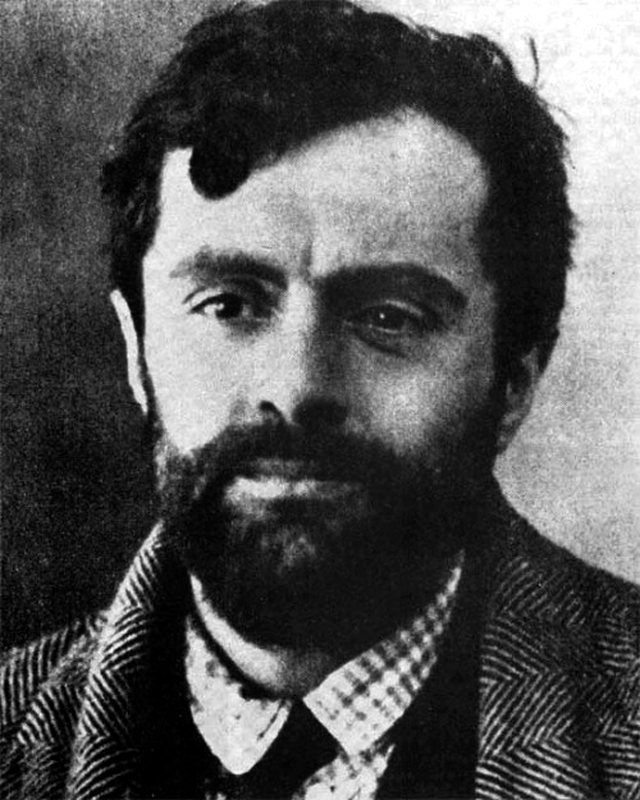
Early Life in Livorno
Amedeo Clemente Modigliani was born on 12 July 1884 in Livorno, a Tuscan port city that had long offered refuge to those persecuted for their religion and was home to a large Jewish community. His family was Sephardic Jewish. His father, Flaminio, came from a family of Italian businessmen and was a mining engineer who managed a mine in Sardinia and the family's extensive timberland. His mother, Eugénie Garsin, who was born and raised in Marseille, came from an intellectual and scholarly family whose ancestors had for generations lived along the Mediterranean coast and had founded a school of Talmudic studies.
The year before his birth a collapse in the price of metal had brought financial ruin to the Modigliani family. Amedeo was the fourth child, and the family treasured the story that his birth saved it from ruin, since according to an ancient law creditors could not seize the bed of a woman in labour. His mother, using her social connections, established a school, which she ran with her two sisters and which became a successful enterprise, and she taught Amedeo at home until he was ten.
His health was fragile. He suffered an attack of pleurisy at about eleven and, some years later, typhoid fever, and at sixteen he was taken ill again and contracted the tuberculosis that would eventually kill him. His mother, who recorded in her diary when he was eleven that she wondered whether the child might perhaps be an artist, was instrumental in his vocation. After his recovery she took him on a tour of southern Italy, to Naples, Capri, Rome and Amalfi, and then north to Florence and Venice.
Art Student Years
Modigliani drew and painted from a very early age, and his mother wrote that he already thought of himself as a painter before he had begun any formal study. At fourteen, while sick with typhoid fever, he is said to have raved in delirium that he wished above all to see the paintings in the Palazzo Pitti and the Uffizi in Florence. His mother promised to take him once he recovered, and she allowed him to begin lessons. From 1898 to 1900 he worked at the studio of the painter Guglielmo Micheli in Livorno, where his earliest formal instruction took place in an atmosphere steeped in nineteenth-century Italian art.
From his maternal grandfather, Isacco Garsin, he had been exposed to philosophical literature at an early age, and his reading of Nietzsche, Baudelaire, Carducci and Lautréamont, among others, shaped his belief that the route to creativity ran through defiance and disorder. His letters of 1901, written from Capri, show the increasing influence of Nietzsche on his thinking. His studies continued in Florence and Venice, and the influence of his study of Renaissance art can still be seen in his earliest work in Paris.
Arrival in Paris
In 1906 Modigliani moved to Paris, then the focal point of the avant-garde. He lodged in Montmartre, renting a studio in the Rue Caulaincourt, and drew nudes at the Académie Colarossi. According to those who knew him in the first months, he was reserved, even somewhat apart, and well dressed, a young man of a good family trying to maintain appearances. He met Picasso, and he met Constantin Brâncuși, and in the years that followed he made friends of Jacob Epstein, Chaïm Soutine, Maurice Utrillo and others.
Within a year or so his demeanour and reputation changed. He cast off the trappings of his bourgeois upbringing, discarded the Renaissance reproductions that decorated his studio, and destroyed a great deal of his early work, which he described as childish baubles. Many of his acquaintances considered him a bohemian, and he acquired a reputation for hard living. Scholars have suggested that his tuberculosis, which was highly feared and stigmatised at the time and which he kept largely secret, lay behind much of this behaviour, since a drunkard was tolerated in a way that a carrier of infectious disease was not.
Working at a furious pace, he drew constantly, sometimes making as many as a hundred drawings in a day, and many of these were lost, destroyed by him, abandoned in his frequent changes of address or given away. He was at first influenced by Toulouse-Lautrec, and about 1907 he became fascinated by Cézanne. In 1910 he met the Russian poet Anna Akhmatova, then twenty-one, and they began a relationship that lasted about a year.
Sculpture
In 1909 Modigliani returned to Livorno, weakened by his way of life, but he was soon back in Paris, this time in Montparnasse. He originally saw himself as a sculptor rather than a painter, and he was encouraged to continue by the young dealer Paul Guillaume, who took an interest in his work and introduced him to Brâncuși. He was a disciple of Brâncuși for a year. From 1909 until 1914 he devoted himself mainly to sculpture, and a group of his heads was shown with the Cubists of the Section d'Or at the Salon d'Automne of 1912.
The sculpted heads, with their elongated faces, narrow noses and mask-like features, reflect the influence of African sculpture, and of Brâncuși's reduction of form. By 1914 he abandoned sculpture and concentrated on painting, a move precipitated by the difficulty of obtaining sculptural materials after the outbreak of the First World War and by his deteriorating health. The stylisation of the sculpted head nevertheless carried over into the painted portraits for which he is best known.
The Portraits
Modigliani's art is above all that of the portrait and the human figure. He painted the artists and writers of Montmartre and Montparnasse, among them Chaïm Soutine, Moïse Kisling, Pablo Picasso, Diego Rivera, Juan Gris, Max Jacob, Jacques Lipchitz, Blaise Cendrars and Jean Cocteau. He painted Soutine several times when they lived near each other in the Cité Falguière around 1916. He also painted dealers, patrons and friends, and a large number of women, among them Beatrice Hastings, an English poet and critic with whom he lived for almost two years and who was the subject of several of his portraits, including Madame Pompadour.
His mature style combines a flowing line with a flattened, simplified, softly modelled surface. Faces are elongated, necks lengthened, eyes often almond-shaped and sometimes blank, and the shoulders slope in a way that recalls both the figurative painters of the Italian Renaissance and the linear forms of African sculpture, rather than the naturalism of the nineteenth century. He did not belong to any of the prevailing movements of his time, whether Cubism, Futurism or Surrealism, and he is generally considered to have been an artist working apart from them, painting, as it has been put, what he saw rather than what would shock.
The Nudes and the 1917 Exhibition
In 1916 Modigliani befriended the Polish poet and dealer Léopold Zborowski and his wife Anna. Zborowski became his principal dealer and friend in his last years, helping him financially, lending him his apartment, supplying models and materials and paying him a daily sum for his work. Under this arrangement Modigliani painted, between 1916 and 1919, the several dozen reclining nudes that constitute many of his best-known works. The nudes depart from his portraits of friends in that they were commissioned and supported by his dealer.
In December 1917 Zborowski organised an exhibition of Modigliani's work at the gallery of Berthe Weill in Paris. It was the only solo exhibition of the artist's lifetime, and it is notorious in the history of modern art for its sensational reception: on the day of the opening the police closed the show on the ground of obscenity, although it continued, probably after the removal of paintings from the shop window. Seven nudes are recorded as having been exhibited.
Jeanne Hébuterne
In the spring of 1917 the sculptor Chana Orloff introduced Modigliani to Jeanne Hébuterne, a nineteen-year-old art student who had posed for Tsuguharu Foujita. She came from a conservative Catholic family which rejected the liaison with a Jewish painter who seemed to them a dissolute vagabond, but she moved in with him in spite of their objections. They lived in a studio in the Rue de la Grande Chaumière, and she became a principal subject of his portraits, which are among the most affecting of his career.
In early 1918, to escape the war, they travelled south to Nice and Cagnes-sur-Mer, where they spent about a year and saw friends including Renoir, Picasso, Giorgio de Chirico and André Derain. Their daughter, also named Jeanne, was born in Nice on 29 November 1918. Modigliani had already had a son, Gérard, with Simone Thiroux. The trip had been organised by Zborowski in the hope that Modigliani and other artists might sell their work to wealthy tourists, but he managed to sell only a few pictures, for a few francs each, although the paintings made at this time include much of the work that is now most admired.
Death and Posthumous Fame
His health deteriorated quickly in the winter of 1919 to 1920. A neighbour who had not heard from the couple for several days found Modigliani in bed, delirious and clinging to Hébuterne, and he died of tubercular meningitis on 24 January 1920 at the Hôpital de la Charité in Paris, at the age of thirty-five. A great funeral was attended by artists of both Montmartre and Montparnasse, and he was buried in Père Lachaise cemetery. The day after his death Hébuterne, then eight months pregnant with their second child, took her own life. Her family allowed her to be reburied beside him in 1930, and a single tombstone now honours them both. His epitaph reads that he was struck down by death at the moment of glory.
Modigliani died with little recognition. During his lifetime he sold a number of works, but never for any great amount of money. After his death his reputation grew steadily, as collectors and museums came to value the particular elegance of his portraits and nudes, and his life has become a subject for novels, plays and films. His daughter Jeanne, adopted after his death by his sister in Florence, wrote a biography of her father, Modigliani: Man and Myth.
Legacy and Market Context
Modigliani is today regarded as one of the central figures of the École de Paris, a painter and sculptor who found a language of his own at a time of competing movements. His long-necked sitters are among the most recognisable images of twentieth-century art, and his work is represented in major museums around the world.
For the collector, the history of the Modigliani estate is an important consideration. There are several catalogues raisonnés of his work, among them the volumes by Ambrogio Ceroni, last updated in 1972, and those by Osvaldo Patani, and the catalogues by different authors do not always agree. The Modigliani estate is described as one of the most problematic in the art world, and the scholar Marc Restellini has spent four decades preparing a new catalogue raisonné. Modigliani is also one of the most frequently faked of artists, and the legend surrounding his short life has long encouraged forgeries of both paintings and sculptures.
For these reasons, independent expert opinion, comprehensive documentation of provenance, a convincing exhibition and publication history and, where appropriate, technical examination are indispensable in considering any work attributed to him. A careful advisor will establish all of these before introducing a work to a prospective buyer, and will treat the absence of a clear history as a reason for caution.