
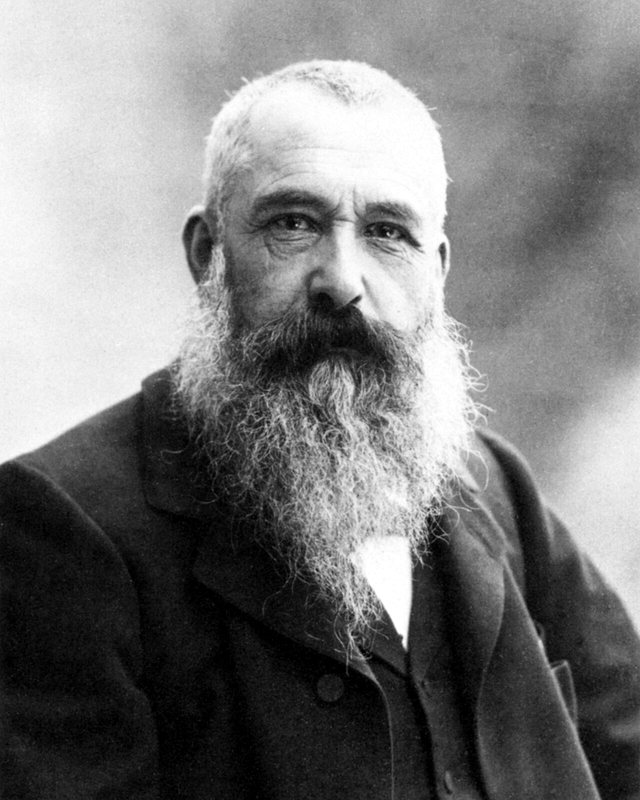
Early Life
Oscar-Claude Monet was born on 14 November 1840 in Paris, the second son of Claude-Adolphe Monet and Louise-Justine Aubrée Monet. In 1845 the family moved to Le Havre, on the Normandy coast, where his father, a wholesale merchant, ran a ship-chandling and grocery business and hoped that his son would eventually join it. Monet wished to be an artist. His mother, who was a singer, supported his ambition, but she died in January 1857, when he was sixteen, and he went to live with his widowed and childless aunt, Marie-Jeanne Lecadre, who remained a source of support in his early career.
Monet entered the secondary school of the arts in Le Havre in 1851 and, though an apathetic student, showed skill from an early age. At fifteen he was drawing caricatures of acquaintances and selling them for money. Around 1858 he met the landscape painter Eugène Boudin, who taught him to paint outdoors, en plein air, and took him on painting excursions along the coast. Monet always regarded Boudin as his master and said that he owed everything to him. It was a lesson that would determine the direction of his whole career.
Paris, Algeria and the Studio of Gleyre
Monet arrived in Paris in April 1859 and immediately visited the Salon, which had just opened. His family refused to finance a conventional academic training, and in 1861 he enlisted for military service with the Chasseurs d'Afrique and was sent to Algeria. The experience was short, for illness led to his discharge in November 1862, but it was important to him. He later said that the light and the vivid colours of North Africa contained the gem of his future researches. In the summer of 1862 he also met the Dutch painter Johan Jongkind, who together with Boudin became an important mentor.
Returning to Paris in December 1862, Monet enrolled in the studio of Charles Gleyre, where he met Pierre-Auguste Renoir and Frédéric Bazille. Bazille eventually became his closest friend. Monet left Gleyre's studio because he disagreed with the master's approach to the presentation of nature, and with Renoir and Alfred Sisley he began to paint in the forests near Fontainebleau and on the Normandy coast, in search of new standards of beauty in conventional subjects.
The Salon and the Years of Struggle
Monet made his Salon debut in 1865, with two Normandy seascapes that received large praise. He hoped that a monumental Le déjeuner sur l'herbe would carry him through in 1866, but he was unable to finish it in time and instead submitted The Woman in the Green Dress, which was accepted. The jury accepted his work only twice more before 1870, in 1866 and 1868, and he made a single final attempt in 1880. His painting Women in the Garden of about 1866 was his first large-scale painting of real success in its handling of light in the open air.
His personal circumstances were difficult. In 1867 his companion and model Camille Doncieux gave birth to their first child, Jean, and his father, who disapproved of the relationship, stopped supporting him. With the help of patrons, notably the collector Louis-Joachim Gaudibert, and of friends including Bazille and later Gustave Caillebotte, he continued to paint, but his creditors pursued him. He married Camille on 28 June 1870, shortly before the outbreak of the Franco-Prussian War. During the war the family took refuge in London and the Netherlands.
In London Monet met Camille Pissarro and, importantly, the dealer Paul Durand-Ruel, who would become his first and principal dealer. He admired the work of Constable and Turner, and was impressed by Turner's treatment of light, especially in his depictions of fog on the Thames.
Argenteuil and Impressionism
In 1871 the family settled at Argenteuil, on the Seine near Paris, where Monet lived for several years. He acquired a boat from which to paint on the river, and the garden of his house became a subject in its own right. Many of his friends came to paint there, and the paintings of these years are among the most characteristic of Impressionism: bright, quick in execution and attentive to reflections, to the movement of water and to the changing sky.
By the early 1870s Monet and a number of like-minded artists, among them Renoir, Pissarro, Sisley, Paul Cézanne, Edgar Degas and Berthe Morisot, resolved to exhibit independently of the Salon, under the title of the Anonymous Society of Painters, Sculptors and Engravers. Their first exhibition opened in 1874. Monet showed several works, including Impression, Sunrise, a hazy view of the port of Le Havre that he had painted in 1872. The critic Louis Leroy, writing a hostile review, seized upon the title and coined the term Impressionism. Conservative critics and the public derided the group, but progressive critics praised its depiction of modern life.
Monet exhibited with the group again in 1876 and in 1877, when he showed paintings from the dozen that he had made at the Gare Saint-Lazare in Paris. The series was well received, and critics particularly praised the way it captured the arrival and departure of the trains. It was the first time that Monet had coordinated so many paintings of the same site, and it anticipated the serial method of his later career. His last exhibition with the Impressionists was in 1882.
Loss and Recovery
The late 1870s were difficult. Camille became seriously ill in 1876, and a second son, Michel, was born in 1878. The family then moved to Vétheuil, where they shared a house with the family of the department store owner and patron Ernest Hoschedé. Camille died in 1879, and Monet's grief, combined with persistent financial difficulty, affected his work. Alice Hoschedé, Ernest's wife, later became his companion and, in 1892, after her husband's death, his second wife.
In the early 1880s his fortunes began to improve as Durand-Ruel had increasing success in selling his paintings. In December 1883 he travelled with Renoir along the Italian Riviera. Returning alone to the town of Bordighera in January 1884, he stayed almost three months instead of the intended three weeks, and produced thirty-eight paintings of its motifs, which he described as a fairy-tale country.
Giverny
In 1883 Monet and his family rented a house with gardens at Giverny, in Normandy, which provided the domestic stability that he had not previously enjoyed. In 1890 he bought the house. He built a greenhouse and a second, skylit studio, and he made the gardens his lifelong concern. He wrote daily instructions to his gardener, designed the plantings himself and owned a collection of botanical books. As his wealth grew, he purchased additional land with a water meadow, and he planted water lilies, both native varieties and cultivars imported from South America and Egypt, so that the pond contained a range of colours. He enlarged the pond in 1901 and again in 1910.
At Giverny he received artists, writers and politicians from France, England, Japan and the United States. Among his friends was the statesman Georges Clemenceau, who later encouraged and supported his large decorative projects. The house also contained his collection of Japanese woodcut prints, which had a pronounced influence on his art.
The Series
Dissatisfied with the limitations of Impressionism, Monet began a number of series of paintings of single subjects, painted at different hours and in different seasons: the haystacks of 1890 and 1891, the poplars, and the façade of Rouen Cathedral, which he painted repeatedly in the early 1890s and exhibited in 1895. In these pictures the subject is secondary to the atmosphere, and what is portrayed is the effect of light and weather at a given moment. He would switch between canvases, sometimes working on as many as eight at one time and usually spending about an hour on each, as the light changed.
He also made repeated visits to London between 1899 and 1901, staying at the Savoy Hotel and painting the Thames, Waterloo Bridge, Charing Cross Bridge and the Houses of Parliament. In the autumn of 1908 he visited Venice with Alice, and the paintings of the city that followed were shown in Paris in 1912. He later wrote that it was a misfortune not to have come to Venice when he was younger.
The Water Lilies
From 1899 Monet began to paint the water garden at Giverny, first with the Japanese bridge as its focus. This group was exhibited in 1900. The water lilies subsequently occupied him for around twenty years, and became his last and most ambitious sequence of paintings. In 1909 an exhibition of forty-two canvases of the water garden was held at Durand-Ruel in Paris, and a critic observed that Monet had reached the ultimate degree of abstraction and imagination joined to the real. In later canvases the horizon vanishes, and the surface of the pond, with its reflections of sky and clouds and its floating plants, becomes the entire subject.
Personal loss shadowed these years. Alice died in 1911, and his son Jean died in 1914. By around this time Monet had also begun to notice the first signs of cataracts, and his perception of colour gradually changed. Encouraged by Clemenceau, in 1914 he made plans to build a large new studio in which to paint a decorative cycle devoted to the water garden, and most of this work took place between about 1916 and 1921. He labelled his tubes of paint, kept a strict order on his palette and, as his sight deteriorated, relied increasingly on memory and imagination.
Monet long resisted surgery, but he eventually underwent cataract operations in 1923. The recovery was difficult, but by 1925 his vision had improved, and he retouched some earlier works. During the First World War, in which his younger son Michel served, he painted a series of weeping willows as a tribute to the French fallen.
Death and Legacy
Claude Monet died of lung cancer on 5 December 1926, at the age of eighty-six, and was buried in the church cemetery at Giverny. At his wish the funeral was simple, and only about fifty people attended. Clemenceau, it is recorded, removed the black cloth from the coffin and replaced it with a flowered one, saying that there should be no black for Monet. The great water lily decorations were installed at the Musée de l'Orangerie in Paris, opening to the public in 1927. Their reception was at first muted, but in the 1950s they were rediscovered by a younger generation of artists, and the Abstract Expressionists in particular admired their scale and freedom.
Monet's son Michel bequeathed the house, garden and water lily pond to the Académie des Beaux-Arts in 1966, and through the Fondation Claude Monet they have been open to visitors since 1980. The movement that took its name from Impression, Sunrise is now familiar around the world, and his late work has been seen as a bridge between the nineteenth century and the abstraction of the twentieth.
Collecting Monet
Monet worked for more than six decades and produced an extremely large body of work, including many versions of the same subject. For the collector, a first question is one of identification: which of several related canvases is under consideration, from which period, and with what history. The scholarly basis for the study of his paintings is the catalogue raisonné compiled by Daniel Wildenstein, and the exhibition history, publication record and provenance of a work, including its history in the period of the Second World War, are essential subjects of investigation. A careful advisor will examine each of these, together with the condition and the quality of the work, before any approach is made to an owner.